In the heart of the Mexican southeast, under the inclement sun of Merida, Yucatan, a renowned food processor took a decisive step towards energy sustainability. The solution: a field-mounted 500 kW photovoltaic system.

The challenge
The plant operates almost continuously, and its energy consumption is high, mainly due to cooling systems and automated processing lines. In addition, the terrain available for the installation was not completely flat or uniform, which represented a technical challenge from the start.
The solution
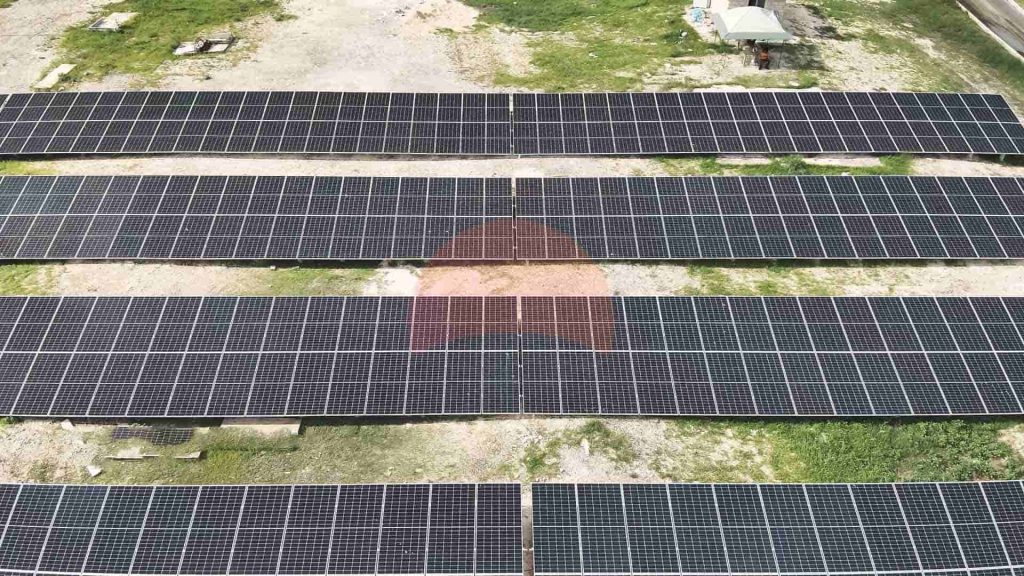
We opted for a groundmount type installation, anchored directly to the ground. To ensure the stability of the structure, a drilling method was used: the ground was drilled to specific depths to insert the structural posts. These poles were cast in place with concrete, guaranteeing long-term resistance to the winds characteristic of the area.
The system was distributed in perfectly aligned rows, optimizing the solar collection throughout the day. High-efficiency solar panels and three centralized inverter were used, which made it possible to maximize performance and reduce points of failure.
Results
Since its commissioning, the system has generated an average of 75,000 kWh per month, covering 10% of the plant’s energy consumption. This has resulted in a reduction in operating costs, not counting the tax benefits associated with investing in clean energies.
In addition to the economic savings, the company has managed to reduce its carbon footprint significantly, improving its image to customers and business partners increasingly aware of the environmental impact.
Brands that trust Solarfy









GET IN TOUCH
Let`s Talk
Seamless deployment
A key aspect of the project was the execution without affecting the daily operation of the company. The excavation, laying and wiring works were carried out in phases, with strict EHS controls and coordination with the customer’s technical team.
The system was connected to the internal network through an interconnection under zero export scheme, which allowed surpluses to be injected into the network during off-peak hours, compensating for nighttime consumption.

Measurable and sustainable results
Since its entry into operation, The company has stopped emitting about 480 tons of CO₂ per year, the equivalent of planting more than 10,000 trees. This has strengthened its positioning as a responsible brand, aligned with increasingly demanding sustainability standards in the food chain.